-
7e
CHAPTERRelevance of Matrix-assisted Laser Desorption Ionization Time-of-Flight in Sepsis
Alladi Mohan, B Venkata Rami Reddy, G Bindhu Madhavi
ABSTRACT
Matrix-assisted laser desorption ionization time-of-flight (MALDI-TOF) is a rapid mass spectrometry (MS) technology emerging as potential tool for identification microorganisms. It is a useful, rapid, and accurate tool for routine laboratory analysis in the diagnosis of sepsis current published data suggests that MALDI-TOF MS surpasses conventional diagnostic methods in terms of cost, speed, and accuracy in microbial species identification. In many cases, this leads to a reduction in the time to appropriate therapy and even decrease in the length of hospital stay. Antibiotic susceptibility and antibiotic resistance are also being detected by using MALDI-TOF. Implementation of MALDI-TOF provides rapid information that is useful for the clinical management of sepsis. Future advances in MALDI-TOF focus to replace traditional methods for identifying microorganisms causing sepsis and improve infectious disease diagnosis and clinical care of patients with sepsis. Research into use of MALDI-TOF for identifying antimicrobial resistance patterns, detection of virulence factors may also help in epidemiological studies in this area, thereby additionally benefiting patient care.
INTRODUCTION
Matrix-assisted laser desorption/ionization time-of-flight mass spectrometry (MALDI-TOF MS) is a rapid mass spectrometry technology which emerged almost two decades ago for identification of microorganisms. It is convenient, rapid, accurate, and cost-effective tool for routine laboratory analysis. Rapid availability of results and detection of organisms causing sepsis allows early administration of targeted antimicrobial treatment thereby potentially improving clinical outcome and also reducing length of hospital stay and associated costs. In this chapter the development and utility of MALDI-TOF MS for the identification etiological causes of sepsis and the effect on patient outcomes. Current and future applications, of MALDI-TOF MS will also be described.
SEPSIS
Sepsis is a life-threatening organ dysfunction caused by dysregulated host response to infection and is associated with high morbidity and mortality rates. It is a major health problem leading increased incidence around more than a million populations per year and mortality ranges around one in three to one in six individuals among those who were affected. In 2017 there were 48.9 million cases and 11 million sepsis-related deaths worldwide, which accounted for almost 20% of all global deaths. The World Health Organization (WHO) considers sepsis to be a serious worldwide health threat.
The Surviving Sepsis Campaign recommends attempting to prove the presence of an infection by methods, such as microbiological testing. Prevention, rapid accurate diagnostic tests, and innovative treatments constitute the key interventions of a multimodal approach aimed to improve sepsis outcome. The clinical laboratory plays a key role in the diagnosis of bloodstream infections (BSI) and reducing time to identification and susceptibility is a major goal. The gold standard to detect BSI is blood culture in a liquid media, followed by cultural and biochemical identification of the culprit pathogen. Routine culture methods are not ideal diagnostic tests as the results take several hours to days. Hence, various diagnostic tests like molecular detection are emerging which allows rapid detection of the organism responsible for infection and is both sensitive and cost-effective. More rapid appropriate therapy further more decreases the inadvertent use of antibiotics and the development of resistance.
Evolution of Matrix-assisted Laser Desorption Ionization Time-of-Flight
Novel molecular diagnostic tests are being developed for the identification of microorganisms. In this scenario, mass spectroscopy (MS), as a diagnostic tool has been expanding in recent years. It has shown progress in searching novel diagnostic biomarkers using proteome/metabolome analysis and also in clinical microbiology testing. Of many methods of MS, MALDI-TOF MS is one of the most widely used methods.
In 1988 Tanaka and colleagues have developed soft laser desorption technology, which involves ionization of proteins without destroying. This leads to development of MALDI, for which Tanaka was awarded Noble prize in chemistry in 2002. Later the MALDI method was combined with TOF-MS and became widely used MALDI-TOF MS. It is an analytical technique in which particles are ionized, separated according to their mass-to-charge ratio, and measured by determining the time it takes for these ions to travel to a detector at the end of a time-of-flight tube. The resulting spectrum, with mass-to-charge values along the x-axis and intensity along the y-axis, is compared to a database of spectra from known organisms.
The workflow for the application of MALDI-TOF to the detection of antibiotic resistance mechanisms, advantages and limitations of MALDI-TOF in clinical microbiology laboratory are shown in Figure 1 and Box 1 respectively.
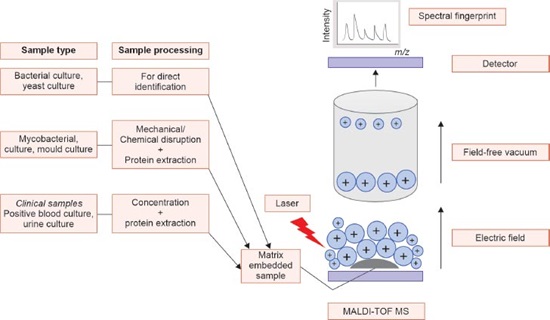
FIG. 1: The workflow for the application of matrix-assisted laser desorption ionization time-of-flight mass spectroscopy (MALDI-TOF MS) to detect antibiotic resistance mechanisms. The samples are deposited on a target plate (either directly or after pre-treatment with a strong organic acid or mechanical lysis) and overlaid with matrix solution. The samples are then subject to soft ionization by short laser pulses resulting in gas phase ions with minimal fragmentation. This is followed by acceleration of particles in a vacuum through an electric field. The amount of time taken by each particle to pass through a field-free tube and reach the detector (time-of-flight, TOF) depends on its mass and charge. After all abundant proteins (predominantly ribosomal proteins) in the sample have been detected by the mass spectrometer (MS); a spectral fingerprint is produced that is specific to the organism. The finger print thus generated is compared with the spectral profiles in a database to identify the organism, antibiotic susceptibility testing, typing, and biomarker detection.
Commercially available kits produced by Bruker and bioMérieux are available for the direct detection of pathogens from positive blood cultures. The MALDI Sepsityper (Bruker Daltonics) and VITEK MS blood culture (bioMérieux) kits both facilitate achievement of the same end goal. These can be used with either MALDI-TOF MS system; however, both use different extraction methods.
Utility of Matrix-assisted Laser Desorption Ionization Time-of-Flight Mass Spectrometry in Sepsis
Matrix-assisted laser desorption ionization time-of-flight mass spectrometry is proven to be a rapid and accurate universal diagnostic method. It reduces the time required to identify the organism and initiation of appropriate treatment in a patient with sepsis. It is also helpful detecting antibiotic susceptibility and antibiotic resistance, thus enabling physicians to determine effective antibiotics and thereby enabling to control the infection. MALDI-TOF MS can identify gram-positive, gram-negative, aerobic, and anaerobic bacteria as well as mycobacteria, yeast, and molds, typically at the species level, with accuracy as good better than traditional methods. By rapidly identifying the etiological organisms causing sepsis, faster switching over to the appropriate antibiotics is possible. This will facilitate effective tailoring and stewardship of antibiotic treatment and better patient outcomes.
BACTERIAL INFECTIONS
Matrix-assisted laser desorption ionization time-of-flight can be used for early detection of bacteria causing various respiratory and urinary tract infections. Several studies have shown that the efficacy of MALDI-TOF in diagnosis is equal to or even more effective than the conventional diagnostic methods. In meningitis MALDI-TOF is used to isolate the organism in cerebrospinal fluid (CSF), thus help in early initiation of appropriate treatment. A few studies suggested that additional pretreatment of body fluids by ammonium chloride, formic acid, or short-term incubation on solid medium improves the diagnostic potential of MALDI-TOF MS. Gram negative (Enterobacteriaceae, Salmonella, Citrobacter, and Pseudomonas) and anaerobic bacteria causing sepsis have been shown to be accurately identified by different MALDI-TOF systems in >95% of the cases and these are more reliable and relevant when compared to conventional methods. Mycobacterium tuberculosis strains are accurately identified by MALDI-TOF and the results are comparable to that of nucleic acid amplification test. However, the sensitivity in detecting nontubercular mycobacteria species is far less than that of the conventional diagnostic tests. Methods for accurate detection of gram-positive sepsis need to be evolved.
YEAST AND FUNGAL INFECTIONS
Yeast and fungi are the most common organisms causing complications in immunosuppressed individuals. Conventional diagnostic methods are time consuming; hence, they lead to increased scope of application of MALDI-TOF in the diagnostic workup of fungal infections causing sepsis. It is less expensive, rapid, accurate, and simple than current gold standard method of identification. Various fungi identified using MALDI-TOF include Fusarium, Aspergillus, Penicillium, Cryptococcus neoformans, and Candida. Further advances are extended to identify noncandida fungi and to make the results more accurate.
OTHER MICROBIAL PATHOGENS
Matrix-assisted laser desorption ionization time-of-flight use in clinical microbiology laboratories is predominantly for identifying bacteria and fungi; not for viruses and parasites. Recent data; however, suggest that MALDI-TOF has been useful in detection of sepsis caused by certain viruses, namely, severe acute respiratory syndrome coronavirus-2 (SARS-CoV-2), Enterovirus, influenza virus, and hepatitis virus.
DETECTION OF ANTIBIOTIC RESISTANCE AND ANTIBIOTIC SUSCEPTIBILITY
Multidrug-resistance is a particularly dramatic problem in severe sepsis, especially in hospital settings and there is a need for the development of rapid and reliable methods for antimicrobial susceptibility testing for the initiation of appropriate treatment. Antimicrobial-resistance to a number of antibiotics belonging to different classes have been successfully tested by MALDI-TOF MS in a variety of clinically relevant bacterial species including members of Enterobacteriaceae family, nonfermenting gram-negative bacteria, gram-positive cocci, mycobacteria, and anaerobic bacteria. This includes detection of methicillin-resistant Staphylococcus aureus (MRSA), beta-lactamases producing aerobic and anaerobic bacteria and carbapenamase producing Enterobacteriaceae. Drug-resistance can also be detected using MALDI-TOF by identifying certain biomarkers.
MALDI-TOF is also used to detect antibiotic susceptibility. By using this one can detect the spectrum of antibiotics against any particular organism. Major focus of future research is to achieve standardization of methods and simultaneous susceptibility testing of microbes to various classes of antimicrobials.
Over the last two decades, MALDI-TOF MS has revolutionized clinical diagnostics with its ability of rapid, reliable and cost-effective method to identify the causative organism of sepsis as well as its potential to antimicrobial susceptibility testing. MALDI-TOF MS surpasses conventional diagnostic methods in terms of cost, speed and accuracy in microbial species identification. Studies have shown that the use of MALDI-TOF MS decreases not only the time to organism identification but also time to institution effective antibiotic therapy and results in considerable cost saving.
CONCLUSION
Future advances in MALDI-TOF focus to replace traditional methods for identifying microorganisms causing sepsis and improve infectious disease diagnosis and clinical care of patients with sepsis. In future, clinical microbiology laboratories may use this technology to provide accurate information regarding drug-resistance information in addition to organism identification. More widespread research and use of the technique will facilitate emergence of user-defined databases and therefore detection of a wider range of microorganisms. Research into use of MALDI-TOF for identifying antimicrobial resistance patterns, detection of virulence factors may also help in epidemiological studies in this area, thereby additionally benefiting patient care.
SUGGESTED READINGS
1. Oviaño M, Rodríguez-Sánchez B. Rodríguez-Sánchez B. MALDI-TOF mass spectrometry in the 21st century clinical microbiology laboratory. Enferm Infecc Microbiol Clin (Engl Ed). 2021;39(4):192-200.
2. Evans L, Rhodes A, Alhazzani W, Antonelli M, Coopersmith CM, French C, et al. Surviving sepsis campaign: international guidelines for management of sepsis and septic shock 2021. Intensive Care Med. 2021;47(11):1181-247.
3. Rudd KE, Johnson SC, Agesa KM, Shackelford KA, Tsoi D, Kievlan DR, et al. Global, regional, and national sepsis incidence and mortality, 1990-2017: analysis for the Global Burden of Disease Study. Lancet. 2020;395(101219):200-11.
4. World Health Organization. Global report on the epidemiology and burden of sepsis: current evidence, identifying gaps and future directions. Geneva: World Health Organization; 2020.
5. Sinha M, Jupe J, Mack H, Coleman TP, Lawrence SM, Fraley SI. Emerging technologies for molecular diagnosis of sepsis. Clin Microbiol Rev. 2018;31(2):e00089-17.
6. Tanaka K, Waki H, Ido Y, Akita S, Yoshida Y, Yoshida T, et al. Protein and polymer analyses up to m/z 100 000 by laser ionization time‐of‐flight mass spectrometry. Rapid communications in mass spectrometry. 1988;2(8):151-3.
7. Dingle TC, Butler-Wu SM. MALDI-TOF mass spectrometry for microorganism identification. Clin Lab Med. 2013;33(3):589-609.
8. Luethy PM, Johnson JK. The use of matrix-assisted laser desorption/ionization time-of-flight mass spectrometry (MALDI-TOF MS) for the identification of pathogens causing sepsis. J Appl Lab Med. 2019;3(4):675-85.
9. Bizzini A, Greub G. Matrix-assisted laser desorption ionization time-of-flight mass spectrometry, a revolution in clinical microbial identification. Clin Microbiol Infect. 2010;16(11):1614-9.
10. Martiny D, Debaugnies F, Gateff D, Gérard M, Aoun M, Martin C, et al. Impact of rapid microbial identification directly from positive blood cultures using matrix-assisted laser desorption/ionization time-of-flight mass spectrometry on patient management. Clin Microbiol Infect. 2013;19(12):E568-81.
11. Bauer KA, Perez KK, Forrest GN, Goff DA. Review of rapid diagnostic tests used by antimicrobial stewardship programs. Clin Infect Dis. 2014;59(Suppl 3):S134-45.
12. Stevenson LG, Drake SK, Murray PR. Rapid identification of bacteria in positive blood culture broths by matrix-assisted laser desorption ionization-time of flight mass spectrometry. J Clin Microbiol. 2010;48(2):444-7.
13. Martiny D, Busson L, Wybo I, El Haj RA, Dediste A, Vandenberg O. Comparison of the microflex LT and Vitek MS systems for routine identification of bacteria by matrix-assisted laser desorption ionization-time of flight mass spectrometry. J Clin Microbiol. 2012;50(4):1313-25.
14. Seng P, Drancourt M, Gouriet F, La Scola B, Fournier PE, Rolain JM, et al. Ongoing revolution in bacteriology: routine identification of bacteria by matrix-assisted laser desorption ionization time-of-flight mass spectrometry. Clin Infect Dis. 2009;49(4):543-51.
15. Segawa S, Sawai S, Murata S, Nishimura M, Beppu M, Sogawa K, et al. Direct application of MALDI-TOF mass spectrometry to cerebrospinal fluid for rapid pathogen identification in a patient with bacterial meningitis. Clin Chim Acta. 2014;435:59-61.
16. Christner M, Rohde H, Wolters M, Sobottka I, Wegscheider K, Aepfelbacher M. Rapid identification of bacteria from positive blood culture bottles by use of matrix-assisted laser desorption-ionization time of flight mass spectrometry fingerprinting. J Clin Microbiol. 2010;48(5):1584-91.
17. Bastin B, Bird P, Benzinger MJ, Crowley E, Agin J, Goins D, et al. Confirmation and identification of Salmonella spp., Cronobacter spp., and other gram-negative organisms by the bruker maldi biotyper method: collaborative study, first action 2017.09. J AOAC Int. 2018;101(5):1593-609.
18. Şamlı A, İlki A. Comparison of MALDI-TOF MS, nucleic acid hybridization and the MPT64 immunochromatographic test for the identification of M. tuberculosis and non-tuberculosis Mycobacterium species. New Microbiol. 2016;39(4):259-63.
19. Welker M, Van Belkum A, Girard V, Charrier JP, Pincus D. An update on the routine application of MALDI-TOF MS in clinical microbiology. Expert Rev Proteomics. 2019;16(8):695-710.
20. Chen JH, Yam WC, Ngan AH, Fung AM, Woo WL, Yan MK, et al. Advantages of using matrix-assisted laser desorption ionization-time of flight mass spectrometry as a rapid diagnostic tool for identification of yeasts and mycobacteria in the clinical microbiological laboratory. J Clin Microbiol. 2013;51(12):3981-7.
21. Do T, Guran R, Adam V, Zitka O. Use of MALDI-TOF mass spectrometry for virus identification: a review. Analyst. 2022;147(14):3131-54.
22. Florio W, Baldeschi L, Rizzato C, Tavanti A, Ghelardi E, Lupetti A. Detection of antibiotic-resistance by MALDI-TOF mass spectrometry: An expanding area. Front Cell Infect Microbiol. 2020;10:572909.
23. Weis CV, Jutzeler CR, Borgwardt K. Machine learning for microbial identification and antimicrobial susceptibility testing on MALDI-TOF mass spectra: a systematic review. Clin Microbiol Infect. 2020;26(10):1310-7.
24. Clerc O, Prod’hom G, Vogne C, Bizzini A, Calandra T, Greub G. Impact of matrix-assisted laser desorption ionization time-of-flight mass spectrometry on the clinical management of patients with Gram-negative bacteremia: a prospective observational study. Clin Inf Dis. 2013;56(8):1101-7.
25. Huang AM, Newton D, Kunapuli A, Gandhi TN, Washer LL, Isip J, et al. Impact of rapid organism identification via matrix-assisted laser desorption/ionization time-of-flight combined with antimicrobial stewardship team intervention in adult patients with bacteremia and candidemia. Clin Inf Dis. 2013;57(9):1237-45.
26. Verroken A, Defourny L, le Polain de Waroux O, Belkhir L, Laterre PF, Delmée M, et al. Clinical impact of MALDI-TOF MS identification and rapid susceptibility testing on adequate antimicrobial treatment in sepsis with positive blood cultures. PLoS One. 2016;11(5):e0156299.
27. Beganovic M, Costello M, Wieczorkiewicz SM. Effect of matrix-assisted laser desorption ionization-time of flight mass spectrometry (MALDI-TOF MS) alone versus MALDI-TOF MS combined with real-time antimicrobial stewardship interventions on time to optimal antimicrobial therapy in patients with positive blood cultures. J Clin Microbiol. 2017;55(5):1437-45.
28. Wang J, Yang C, Tan H, Zhao P, Tie Y, Feng Z. Clinical application of matrix-assisted laser-resolved ionization time-of-flight mass spectrometry for rapid detection of blood-borne pathogens. Altern Ther Health Med. 2023:AT9411.
 Home
Home
e-Contents
Chapter 1e: Prosthetic Valve Thrombosis
Harbir Kaur Rao, Rajinder Singh GuptaChapter 2e: Diabesity and Glucagon-like Peptide-1 Receptor Agonists
Rajiv Awasthi, Avivar AwasthiChapter 4e: Gestational Diabetes Mellitus: An Update
Vinay Kumar Meena, Nazim Hussain, Rajani NawalChapter 5e: Sodium-glucose Cotransporter-2 Inhibitors Beyond Glycemia
Amit VarmaChapter 6e: Intrahepatic Cholestasis
Archith Boloor, Nikhil Kenny ThomasChapter 8e: Tobacco and Chest
Rajbir Singh, Prabhpreet Kaur, BL Bhardwaj, RS BhatiaChapter 9e: Lung Metastasis
RS Bhatia, Prabhpreet Kaur, Rajbir Singh, BL BhardwajChapter 10e: Important Drug Interactions in Clinical Practice
Srirang AbkariChapter 11e: Renal Tubular Acidosis
Surjit TarafdarChapter 12e: Anemia in Chronic Kidney Disease
Saif Quaiser, Ruhi Khan, Shahzad Faizul HaqueChapter 14e: Current Positioning of Nonstatin Therapy of Dyslipidemia
Saumitra Ray, Srina RayChapter 15e: How to Deal with Complication of Prolonged Antibiotic Therapy
Pushpita MandalChapter 16e: Navigating End-of-life Medical Decisions with Cultural Sensitivity
Reinold OB GansChapter 17e: Osteocalcin: New Frontiers in Diabetes
Sudha Vidyasagar, Avinash HollaChapter 18e: Arterial Blood Gas Analysis: A Rational Approach
SV Ramanamurty, TVSP MurtyChapter 19e: Asthma: New Therapeutic Avenues
Sachin Hosakatti